Gardeners of the sea are growing heat-tolerant coral — and a Palawan trial is working
Selectively bred coral fragments on a Philippine reef survived a marine heatwave at rates that stunned even the scientists who planted them. The work is slow, wet, and newly convincing.
Elena Voss, Science editor||3 min read
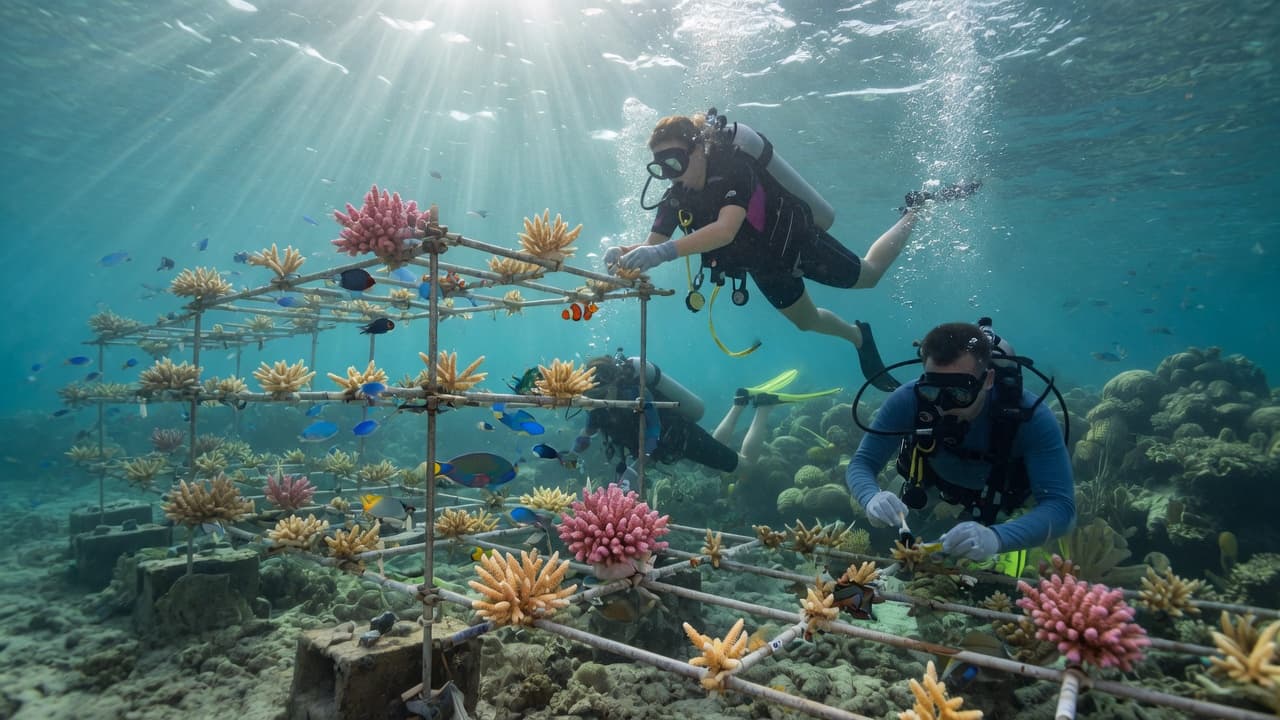
The nursery does not look like a garden from the boat. It looks like a field of metal tables, 12 meters down, each one hung with twigs the color of tea. Those twigs are coral. On a morning in late August, Dr. Isabel Navarro and two technicians clipped, tagged, and re-tied fragments the way orchardists graft apples — except the orchard was on fire two years ago, and this time most of the trees lived.
The Palawan Heat-Hardy trial, run by the Philippine Reef Institute with partners at James Cook University, set out a blunt question: can corals chosen for heat tolerance survive a real marine heatwave better than their wild neighbors? The 2026 warm pulse in the Sulu Sea gave them an unwelcome experiment. It also gave them a result.
Among the selectively bred Acropora on the nursery frames, 78 percent of colonies still showed live tissue after the peak temperatures receded. On adjacent wild plots used as a control, survival was 41 percent. The difference is not a cured reef. It is a statistically loud hint that breeding and outplanting can buy time.
Breeding without fantasy
Coral restoration has a reputation problem, and it earned some of it. Outplanting pretty branches onto a dying reef is gardening in a hurricane. Navarro’s team does not claim to reverse global heating. They claim something narrower: if you choose parent colonies that already shrug at warmer water, raise their larvae in nurseries, and plant them in sites with remaining herbivorous fish, you can keep genetic options in the water while nations cut emissions.
The parents came from four reefs across Palawan that had bleached less than their neighbors in 2016 and 2020. Spawn was collected at night, larvae settled on ceramic plugs, and the plugs sat in a land-based tank where temperature was stepped up in careful increments. The survivors went to sea.
“We are not inventing super-coral in a comic-book sense,” Navarro said on the pier at Honda Bay, salt dried white on her sleeves. “We are amplifying what the reef already knows how to do, and we are doing it faster than chance.”
The work is slow on purpose. Each outplant is mapped. Divers return on a 90-day cycle. Fishermen from the adjacent marine protected area are paid as rangers, which has cut blast-fishing incidents in the trial zone to zero in the last 18 months, according to municipal records.
What success actually looks like
A living fragment is not a recovered ecosystem. The team measures three things that matter to people who eat from the reef: live coral cover, the return of branching structure that fish hide in, and the density of juvenile corals that were not planted by hand — the ones that suggest the site can recruit on its own.
Juvenile recruitment is the number Navarro watches. It ticked up this year for the first time since the trial began in 2023. “If we only have what we glued down, we have a museum,” she said. “If babies settle by themselves, we have a process.”
The science is still local. One archipelago, one genus, one heatwave. Papers are under review. Other labs in Australia, Hawai‘i, and the Florida Keys are running cousin experiments; none of them is a copy-paste solution for every reef.
A reef is also a constituency
The most practical outcome may be political. The municipality of Taytay expanded its no-take zone after the survival numbers circulated at a barangay assembly, illustrated with laminated photos. A skipper who used to roll his eyes at “the coral people,” Ramil Cruz, now runs two of the nursery boats.
“I need fish next year, not a speech,” he said. “If the tables work, I protect the tables.”
That is restoration as a civic habit: not a documentary ending, a maintenance schedule. The hurricane is still the climate. The gardeners are still in the water. This season, more of the twigs are green.
- environment
- oceans
- climate
- philippines