MIT Students Win NASA's LunaRecycle Challenge With a Machine That Turns Moon-Base Trash Into Parts
An MIT student team called CERBERUZ took first prize in both the prototype and digital twin tracks of NASA's LunaRecycle Challenge, earning $775,000 in final-round awards for a system that grinds mixed packaging waste into composite feedstock for tools and spare parts on a future lunar outpost.
Just News Desk, Correspondent||5 min read
CAMBRIDGE, Mass. - A team of students at the Massachusetts Institute of Technology has won NASA's LunaRecycle Challenge with a system that grinds the packaging and other trash a future moon base would accumulate into a composite material that can be molded into tools and replacement parts, taking first prize in both of the competition's tracks, according to NASA and MIT. The team, known as CERBERUZ, received a total of $775,000 in awards in the challenge's final phase, NASA said, and $925,000 over the full two-year competition, according to MIT.
The problem the students set out to solve is a mundane one with large consequences. A lunar outpost would receive a steady stream of supplies from Earth, and with them a growing pile of foam, plastic and other packaging, while astronauts would need a steady supply of parts to keep the outpost running. Launching material from Earth is enormously expensive.
"Waste packaging materials will inevitably accumulate when a lunar outpost is built, and at the same time, outpost construction and maintenance will require a steady supply of new materials, including replacement parts," George Lordos, a research scientist in MIT's Department of Aeronautics and Astronautics and the team's lead adviser, told MIT News. "Recycling waste materials into such parts can help reduce materials needed to be launched from Earth."
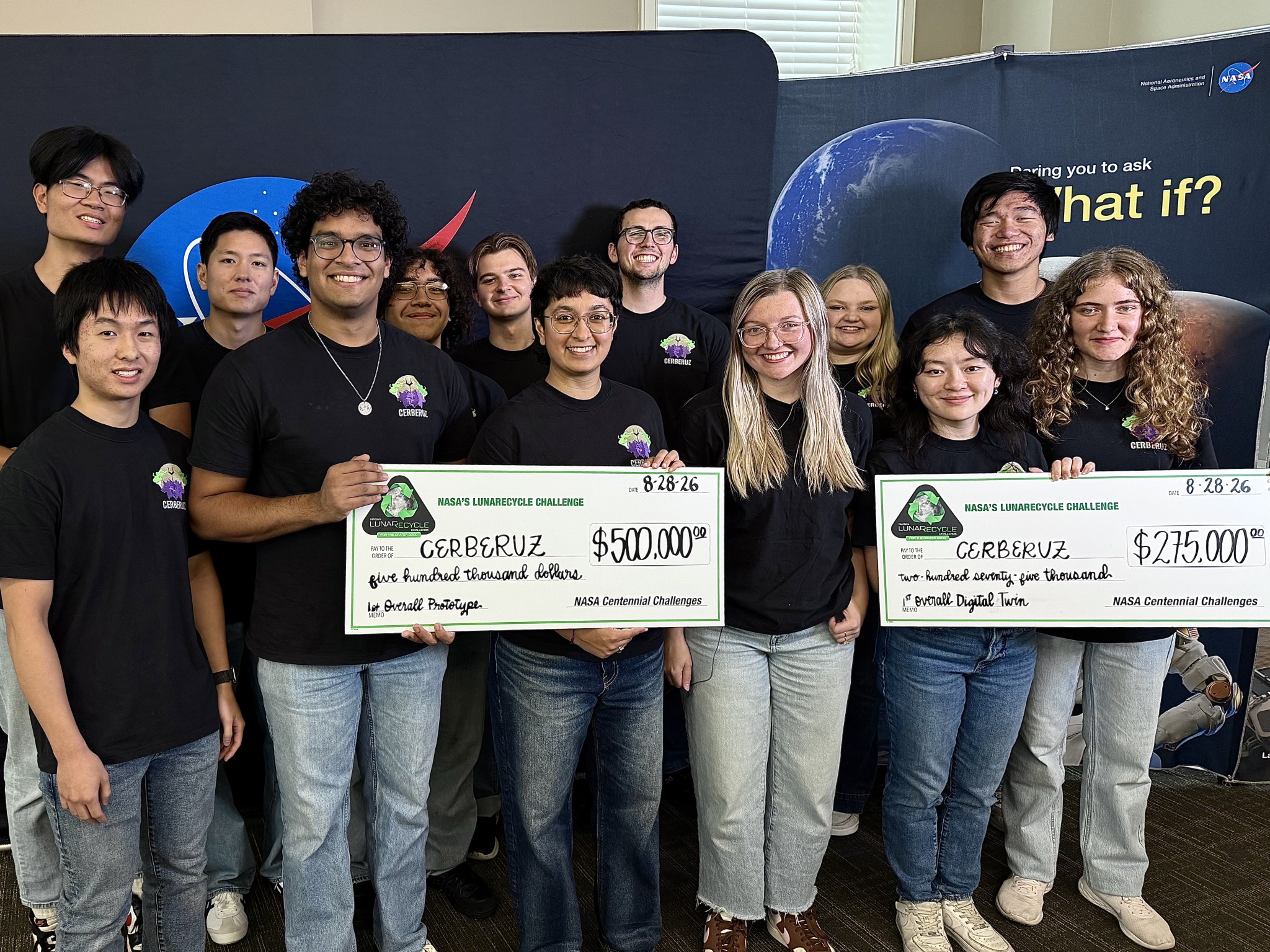
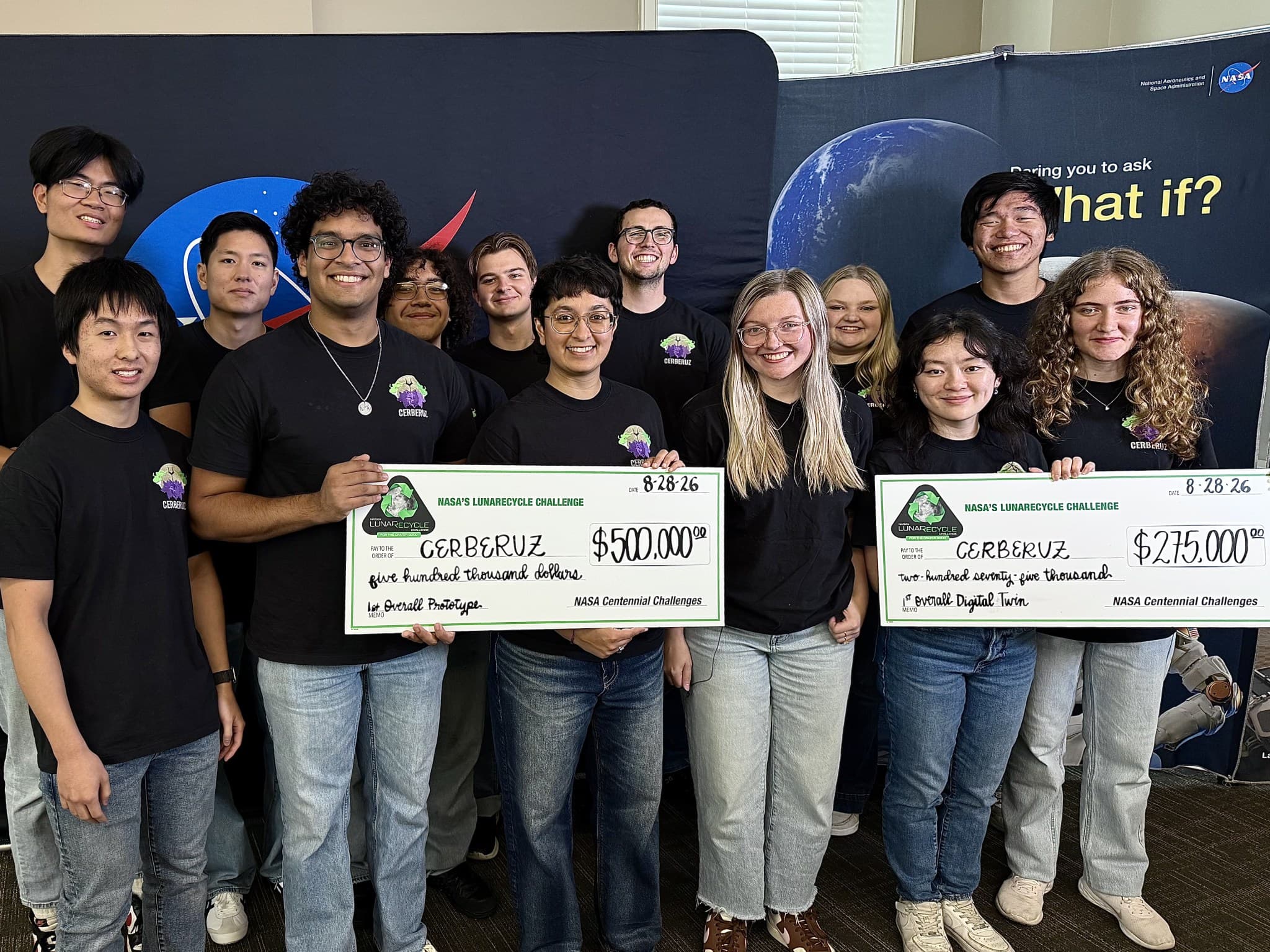
Members of MIT's CERBERUZ team, 14 of its roughly 30 students, hold checks for $500,000 and $275,000 after NASA named them first-prize winners of the LunaRecycle Challenge at the University of Alabama in Tuscaloosa on Aug. 28, 2026. Photo: NASA/Savannah Bullard. Source page: https://www.nasa.gov/directorates/stmd/prizes-challenges-crowdsourcing-program/centennial-challenges/nasa-awards-first-prize-in-phase-2-of-agencys-lunarecycle-challenge/
NASA announced the result on Aug. 28 at the end of a five-day finale at the University of Alabama's Lee J. Styslinger Jr. College of Engineering in Tuscaloosa, where 14 finalist teams from across the United States demonstrated their prototypes. MIT News published a detailed account of the team's work on Oct. 20. LunaRecycle, part of NASA's Centennial Challenges program, is a $3 million, two-phase competition run in partnership with the university and managed at NASA's Marshall Space Flight Center in Huntsville, Ala.
The MIT system, as the university describes it, separates non-biological waste into two streams: thermoplastics, which melt, and everything else. Both are ground into a fine powder and mixed. In an injection molding machine the team nicknamed PERSEPHONE, the plastic melts and carries the other material suspended within it into a mold, producing composite parts that can be replicated quickly. NASA said the resulting powder can also serve as feedstock for 3D-printing filament.
The team's most unusual choice concerned Zotek F30, a lightweight closed-cell foam common in aerospace packaging. Mixtures of thermoplastics and thermoset foams like Zotek have no established recycling method even on Earth, according to MIT. Rather than treat the foam as contamination to be sorted out, the students used it as a reinforcing filler. The foam is so light, said José Soto, a graduate student who led the team's pre-processing work, that "one person can carry them on their head like it's nothing," referring to the large shipments the team received. "The box is the size of a person."
Because the process is mechanical and runs on electricity, it requires no water and no chemical breakdown of the plastics, and produces no secondary chemical waste, MIT said.
"We set out to build something that would actually make sense on the moon, not just in a lab," said Lanie McKinney, a graduate student in aeronautics and astronautics and the team's leader. "That means no water and no chemicals you can't replace."
Alongside the machine, the team built a digital twin, a software model it calls DEIMOS, which uses data from real production runs to predict how a given blend of recycled material and part shape will behave in the mold, including how well it fills and whether it is likely to warp or shrink. The aim, according to MIT, is to let astronauts know how a part will turn out before they spend scarce material making it.
Promotional artwork for NASA's LunaRecycle Challenge, showing an astronaut on the lunar surface with the challenge logo (illustrative). Image: NASA. Source page: https://www.nasa.gov/prizes-challenges-and-crowdsourcing/centennial-challenges/lunarecycle/
"The LunaRecycle Challenge finale is the culmination of two years of innovation spurred by this competition," Jennifer Edmunson, program manager for Centennial Challenges at Marshall, said in NASA's announcement. "It's incredible to see these technologies go from concept to prototype and digital twin demonstrations in that time."
NASA also awarded prizes to nine other teams. In the prototype track, Terasynth of Orlando, Fla., placed second overall and won $225,000, and also took the $25,000 people's choice award. Moon Made of Boulder, Colo., placed second in the digital twin track, winning $125,000. Penn State's RECLAIM team, Cislune of Rosemead, Calif., Team Lovegrove of Bob Jones University and Waste Parrot Technologies of New York won category prizes.
CERBERUZ grew out of the MIT Space Resources Workshop, a student initiative founded in 2017 that builds teams for NASA-sponsored competitions, and drew undergraduate and graduate students from four MIT departments. Jeffrey Hoffman, an MIT professor and former NASA astronaut, advised the team with Mr. Lordos. The team was a Phase 1 winner in 2025 and won milestone prizes in both tracks during Phase 2, according to MIT, and plans to reinvest its winnings in the workshop.
"What impresses me most about this team is the quality of leadership," Mr. Lordos said, adding that "Lanie McKinney has been an outstanding team lead." He credited co-leads Palak Patel, Lilly Etzenbach and Mr. Soto with building and managing subteams.
Mr. Soto said the work could matter beyond the moon. "If we're able to reduce the amount of waste that's inevitably going to be left on the moon, rather than letting it pile up like a landfill," he said, "we can preserve both the beauty of the moon and make exploration more efficient and sustainable."
Sources: MIT News, Rachel Ornitz, "MIT student team CERBERUZ wins NASA LunaRecycle Centennial Challenge, turning lunar trash into tools," Oct. 20, 2026, https://news.mit.edu/2026/mit-student-team-cerberuz-wins-nasa-lunarecycle-centennial-challenge-1020 ; NASA, Bailey Light, "NASA Awards First Prize in Phase 2 of Agency's LunaRecycle Challenge," Aug. 28, 2026, https://www.nasa.gov/directorates/stmd/prizes-challenges-crowdsourcing-program/centennial-challenges/nasa-awards-first-prize-in-phase-2-of-agencys-lunarecycle-challenge/ ; NASA LunaRecycle page, https://www.nasa.gov/prizes-challenges-and-crowdsourcing/centennial-challenges/lunarecycle/ . MIT photographs by José Soto are not used because they are not openly licensed; images are NASA as noted.
- science
- space
- moon
- recycling
- nasa
- mit