Japan Launches MMX, a Mission to Bring Home the First Samples From a Moon of Mars
JAXA's Martian Moons eXploration spacecraft lifted off on an H3 rocket from Tanegashima and is healthy on its way to Mars, where it is to land twice on Phobos and return at least 10 grams of the moon's surface to Earth in 2031.
Just News Desk, Correspondent||6 min read
TANEGASHIMA, Japan - Japan's space agency launched a spacecraft toward Mars on Tuesday on a mission to land on the Martian moon Phobos and bring a sample of its surface back to Earth, an attempt that, if it succeeds, would be the first return of material from the Martian system. The Martian Moons eXploration spacecraft, known as MMX, lifted off aboard the H3 rocket's 10th flight from the Tanegashima Space Center at 4:41:03 a.m. local time on 20 October, which was 3:41 p.m. Eastern time on Monday, and separated from the rocket about 71 minutes later, the Japan Aerospace Exploration Agency said.
In a brief statement after the launch, the agency, known as JAXA, said the H3 "flew as planned," that separation of the spacecraft was confirmed approximately 71 minutes and 13 seconds after liftoff, and that MMX had been injected into its predetermined orbit.
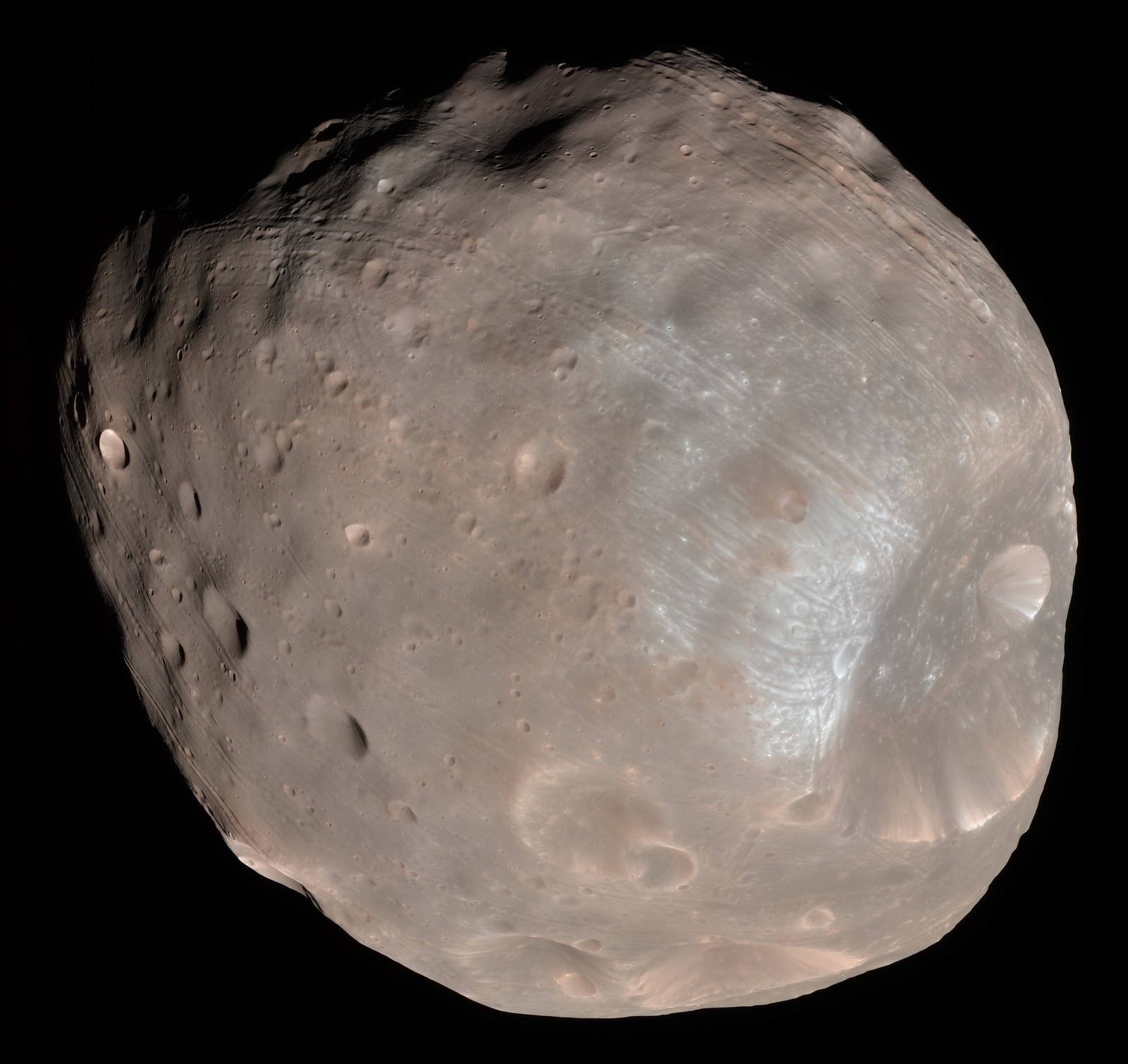
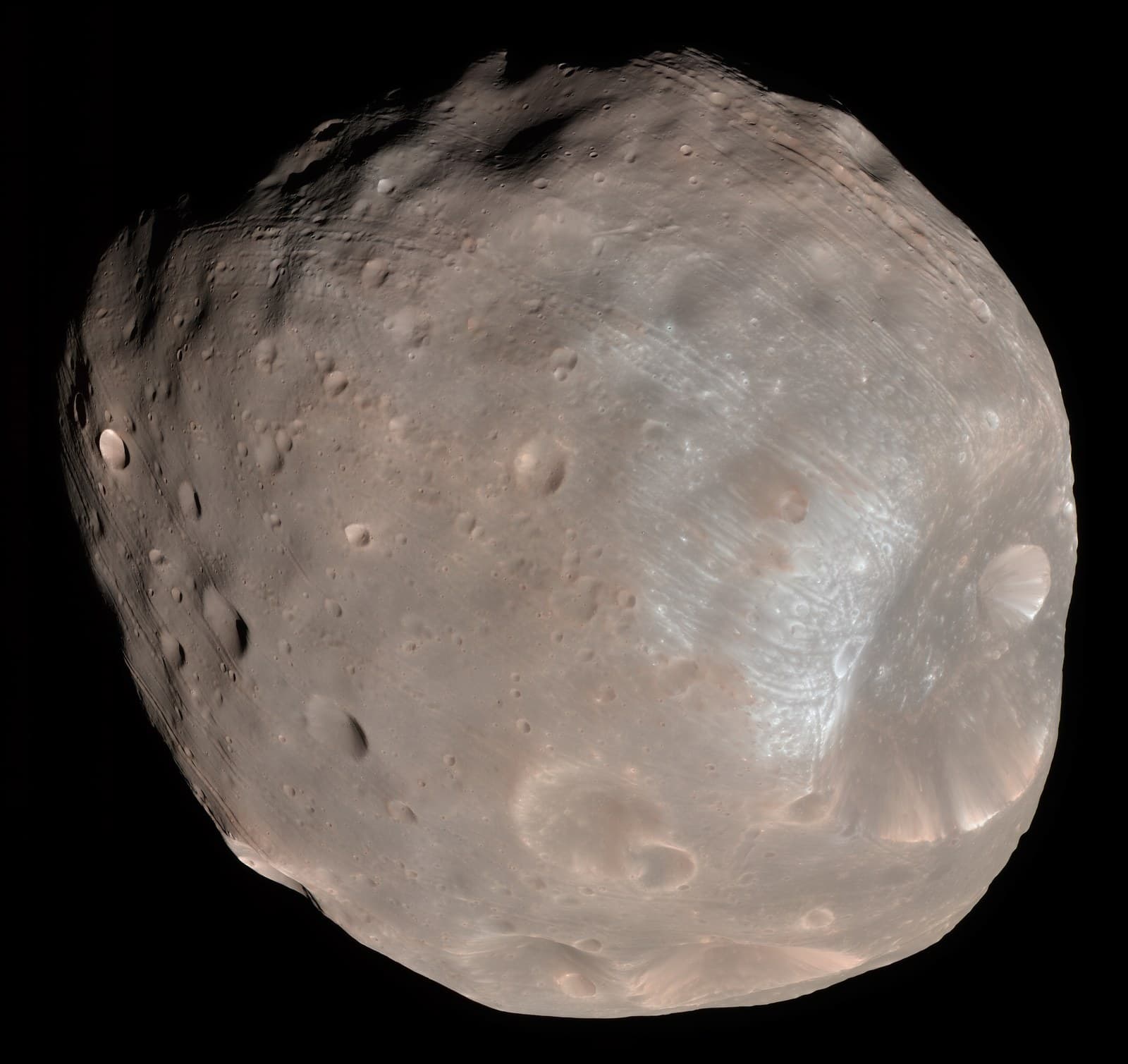
Phobos, the larger of Mars's two moons, in enhanced color, imaged by the HiRISE camera on NASA's Mars Reconnaissance Orbiter on 23 March 2008. Image: NASA/JPL-Caltech/University of Arizona (PIA10368), public domain, via Wikimedia Commons. Source page: https://commons.wikimedia.org/wiki/File:Phobos_colour_2008.jpg
On Wednesday, JAXA said the spacecraft had come through the most delicate stretch of its first days in space. The agency confirmed that the critical sequence of early operations, including deployment of the solar array paddles, establishment of three-axis attitude control and release of the hold-down mechanism on the medium-gain antenna, had been completed and that the spacecraft was in good health. Engineers will now check the onboard instruments while preparing for the outbound cruise toward Mars.
"We have confirmed that the probe is in a stable condition," Yasuhiro Kawakatsu, a professor at JAXA's Institute of Space and Astronautical Science and the leader of the MMX mission, said at a news conference after the launch, according to Jiji Press.
The mission's target is a small, heavily cratered moon that JAXA describes as never having been explored. According to JAXA's mission schedule, MMX is to travel for about a year to reach the Martian system in 2027, enter a quasi-satellite orbit around Phobos and spend roughly three years studying it, collecting material through two soft landings on the surface. It is also to observe Mars's smaller moon, Deimos, before departing in 2030. In 2031, the spacecraft is to release a capsule carrying the sample for recovery in Australia. JAXA says the goal is to return more than 10 grams of material.
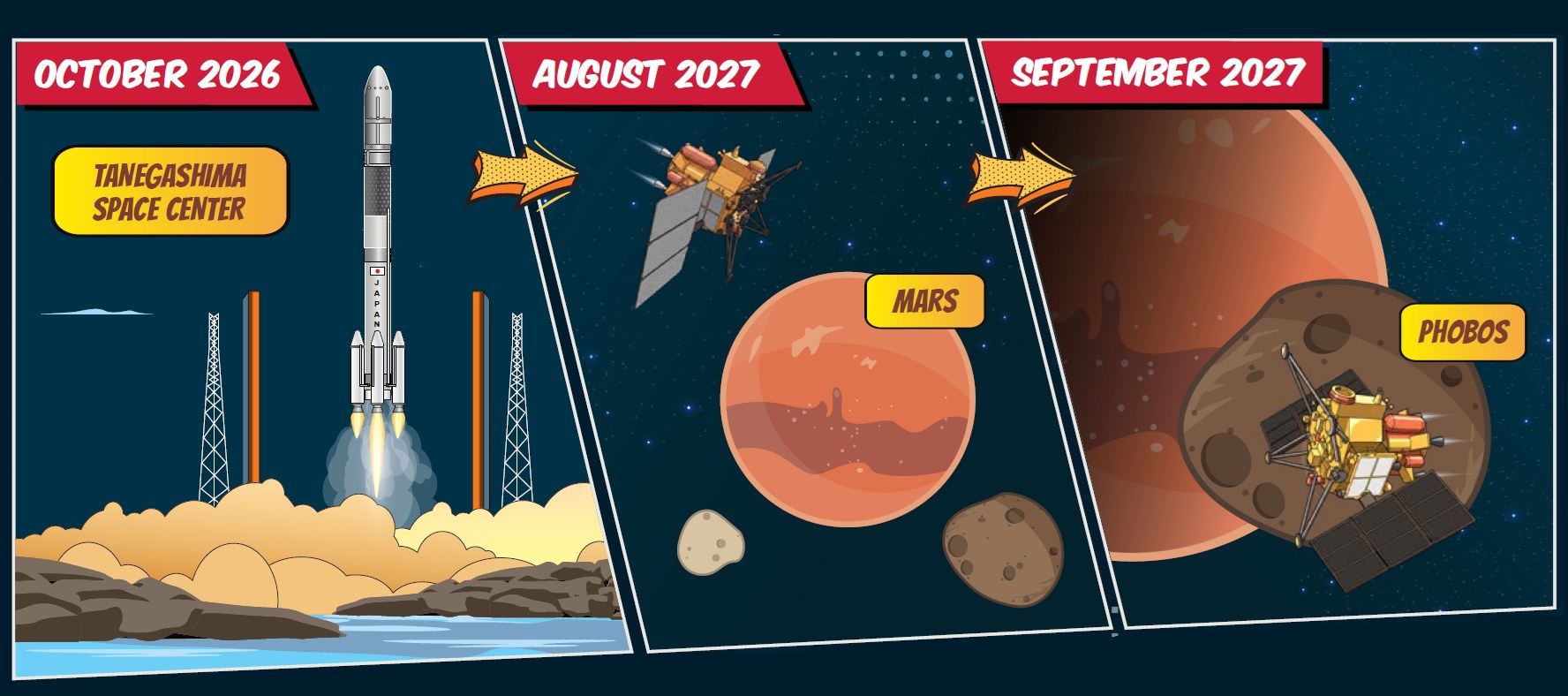
Part of a European Space Agency infographic on the MMX mission, showing launch from Tanegashima Space Center in October 2026, arrival at Mars and entry into orbit around Phobos in 2027. Image: European Space Agency, CC BY-SA 3.0 IGO, via Wikimedia Commons. Source page: https://commons.wikimedia.org/wiki/File:MMX_from_launch_to_Phobos_ESA529680.png
Scientists have long argued over where Phobos and Deimos came from. "Phobos and Deimos may be the remains of a massive impact on Mars that sent material into orbit around the planet, or they could be ancient asteroids that were captured by Mars' gravity billions of years ago," Tom Statler, the MMX program executive and program scientist at NASA headquarters, said in an agency statement before the launch. "Having the answer will help illuminate that early era when Earth and the other inner planets may have been acquiring much of their water and organic compounds."
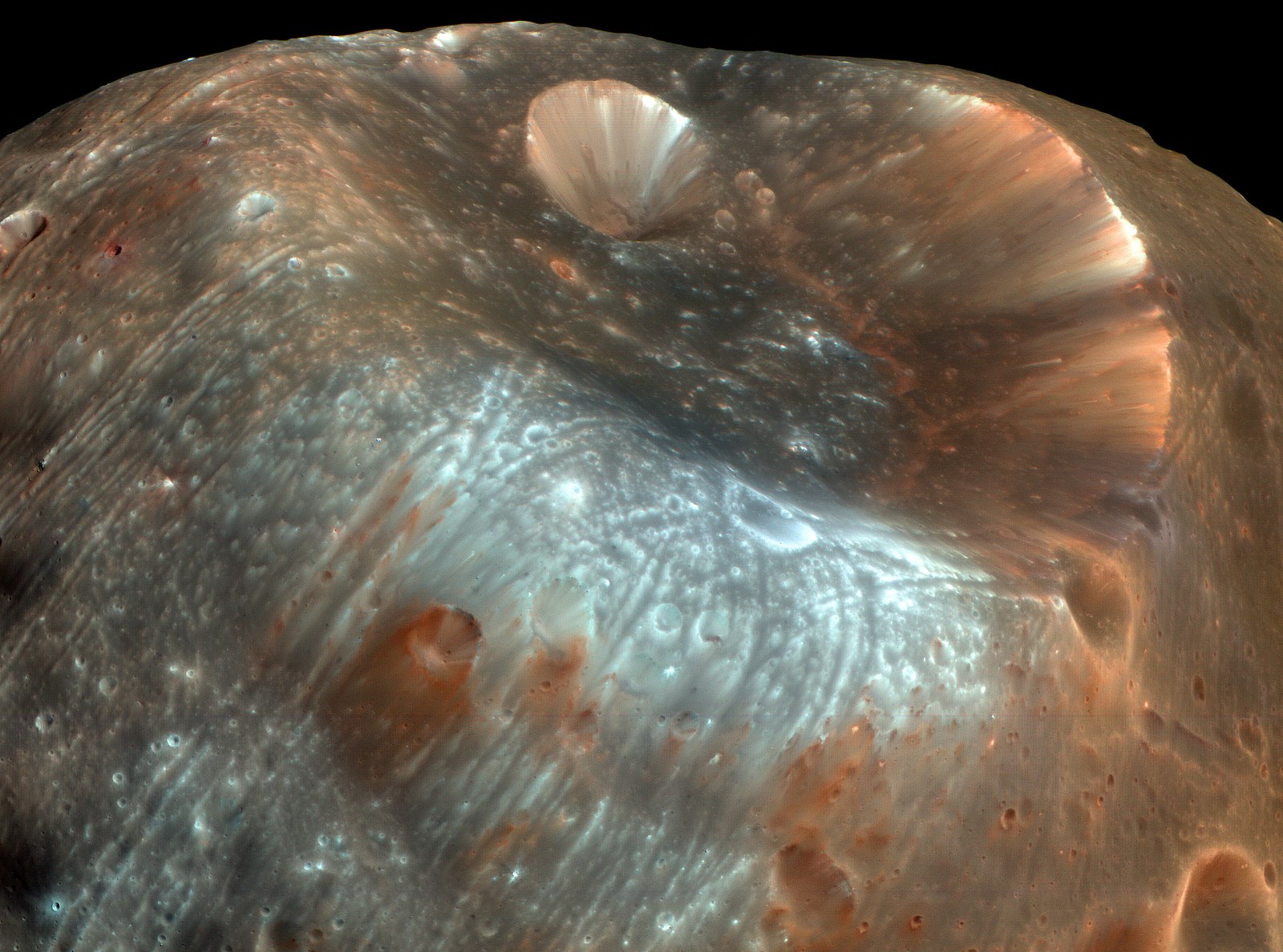
Stickney, the largest crater on Phobos, imaged by the HiRISE camera on NASA's Mars Reconnaissance Orbiter in 2008. Image: NASA/JPL/University of Arizona, public domain, via Wikimedia Commons. Source page: https://commons.wikimedia.org/wiki/File:Stickney_crater_on_Phobos.jpg
The spacecraft is built from three modules, for propulsion, exploration and return, and carries 13 scientific instruments, according to JAXA, which describes MMX as the largest international collaboration in lunar and planetary exploration that Japan has led. NASA's contributions include the MEGANE instrument, whose name is the Japanese word for eyeglasses and which will measure neutrons and gamma rays coming off Phobos to determine the moon's elemental makeup; a pneumatic sampler mounted on one of the landing legs that uses bursts of high-pressure nitrogen gas to gather surface material, complementing a JAXA coring sampler; and communications and navigation support from the Deep Space Network. NASA said it would curate about 15 percent of the returned sample at the Johnson Space Center in Houston.
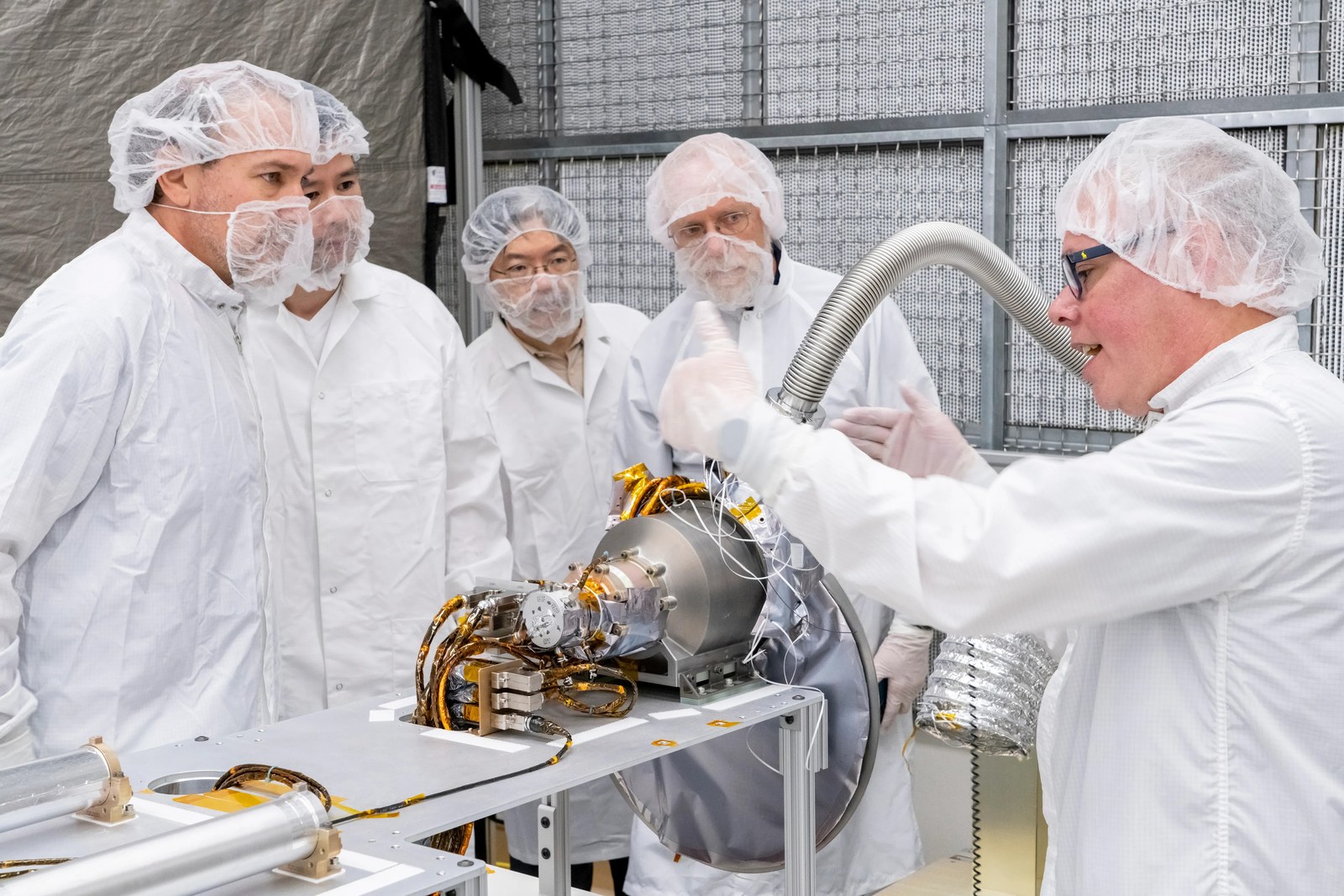
U.S. and Japanese team members examine the gamma-ray spectrometer portion of NASA's MEGANE instrument for MMX during its development at the Johns Hopkins Applied Physics Laboratory, 2024. Photo: NASA/JAXA/Johns Hopkins APL/Ed Whitman, public domain, via Wikimedia Commons. Source page: https://commons.wikimedia.org/wiki/File:MMX_MEGANE_instrument.jpg
"The samples from MMX will bring forth paradigm-shifting science on the Mars system for generations to come, especially as NASA prepares to send the first humans to Mars," said Nicky Fox, associate administrator of NASA's Science Mission Directorate.
The launch is the beginning of what JAXA calls a five-year round trip, and the most demanding steps lie ahead: the approach to Phobos, two landings on its surface and the long journey home. For now, the agency reports a healthy spacecraft on its way, and a long-debated question about the origin of the moons of Mars may, by 2031, have physical evidence to answer it.
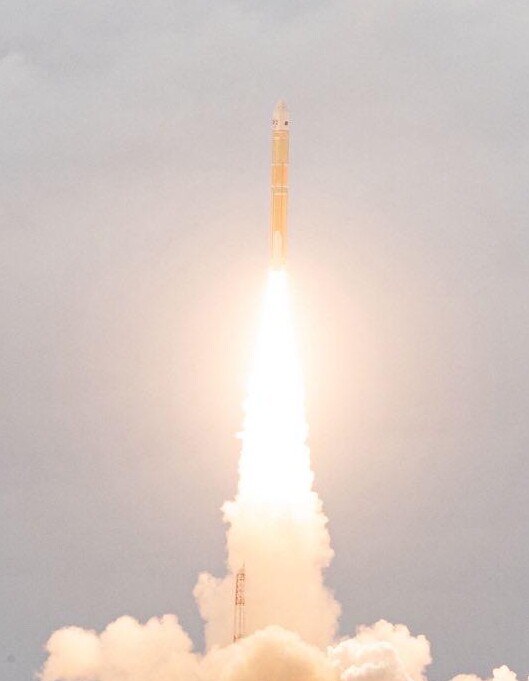
An H3 rocket lifts off from the Yoshinobu Launch Complex at Tanegashima Space Center carrying the Quasi-Zenith Satellite 6 on 2 February 2025. Illustrative; this is an earlier H3 flight, not the MMX launch. Photo: U.S. Air Force (image 250202-F-AF991-1336), public domain, via Wikimedia Commons. Source page: https://commons.wikimedia.org/wiki/File:H3_rocket_launch.jpg
Sources: Japan Aerospace Exploration Agency, "Launch result of the Martian Moons eXploration (MMX) spacecraft aboard H3 Launch Vehicle flight No.10," 20 October 2026 (JST), https://global.jaxa.jp/press/2026/10/20261020-1_e.html ; JAXA, "Completion of the Initial Critical Operations Phase of the Martian Moons eXploration (MMX) Spacecraft," 21 October 2026 (JST), https://global.jaxa.jp/press/2026/10/20261021-1_e.html ; JAXA MMX mission site, https://www.mmx.jaxa.jp/en/ ; NASA, "NASA to Help Unlock Mysteries of Mars' Moons in Upcoming Mission," https://science.nasa.gov/directorates/smd/planetary-science-division/nasa-to-help-unlock-mysteries-of-mars-moons-in-upcoming-mission/ ; NASA MMX mission page, https://science.nasa.gov/mission/mmx/ ; Jiji Press via Nippon.com, 20 October 2026, https://www.nippon.com/en/news/yjj2026102000118/ . JAXA images are not used because they are not openly licensed; images are public domain or Creative Commons as noted.
- science
- space
- mars
- phobos
- jaxa
- japan