Quantinuum Reports a Record in Quantum Error Correction on Its Helios Computer
Quantinuum says its Helios trapped-ion quantum computer reached a logical fidelity of 99.9995 percent, about five uncorrectable errors per million operations, using color codes of increasing size. The company-reported result is described in a preprint that has not been peer reviewed.
Just News Desk, Correspondent||5 min read
BROOMFIELD, Colorado - Quantinuum said on Monday that its Helios quantum computer had reached a logical fidelity of 99.9995 percent in a test of quantum error correction, the equivalent of about five uncorrectable errors in a million operations. The company described the result as a world record, 10 times better than its own mark set in September, and said logical errors fell by an average factor of 12 each time its researchers enlarged the code protecting the information.
The figures come from Quantinuum, which announced them in a press release and a technical blog post on 19 October, and from a research paper by Quantinuum scientists, "Quantum error correction well below the color code threshold," that the company has posted as a preprint. The paper has not been peer reviewed, and the results have not yet been independently reproduced.
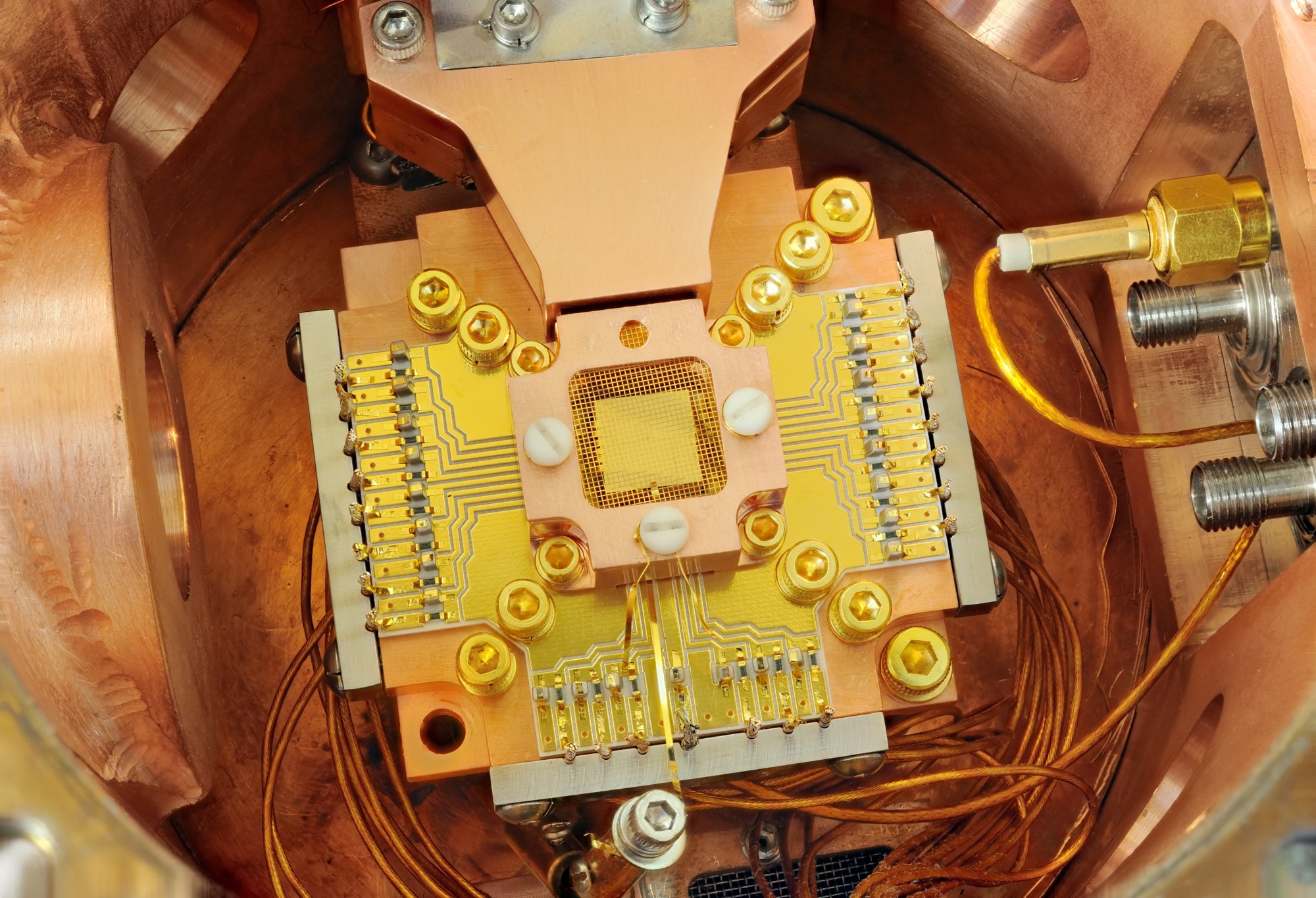
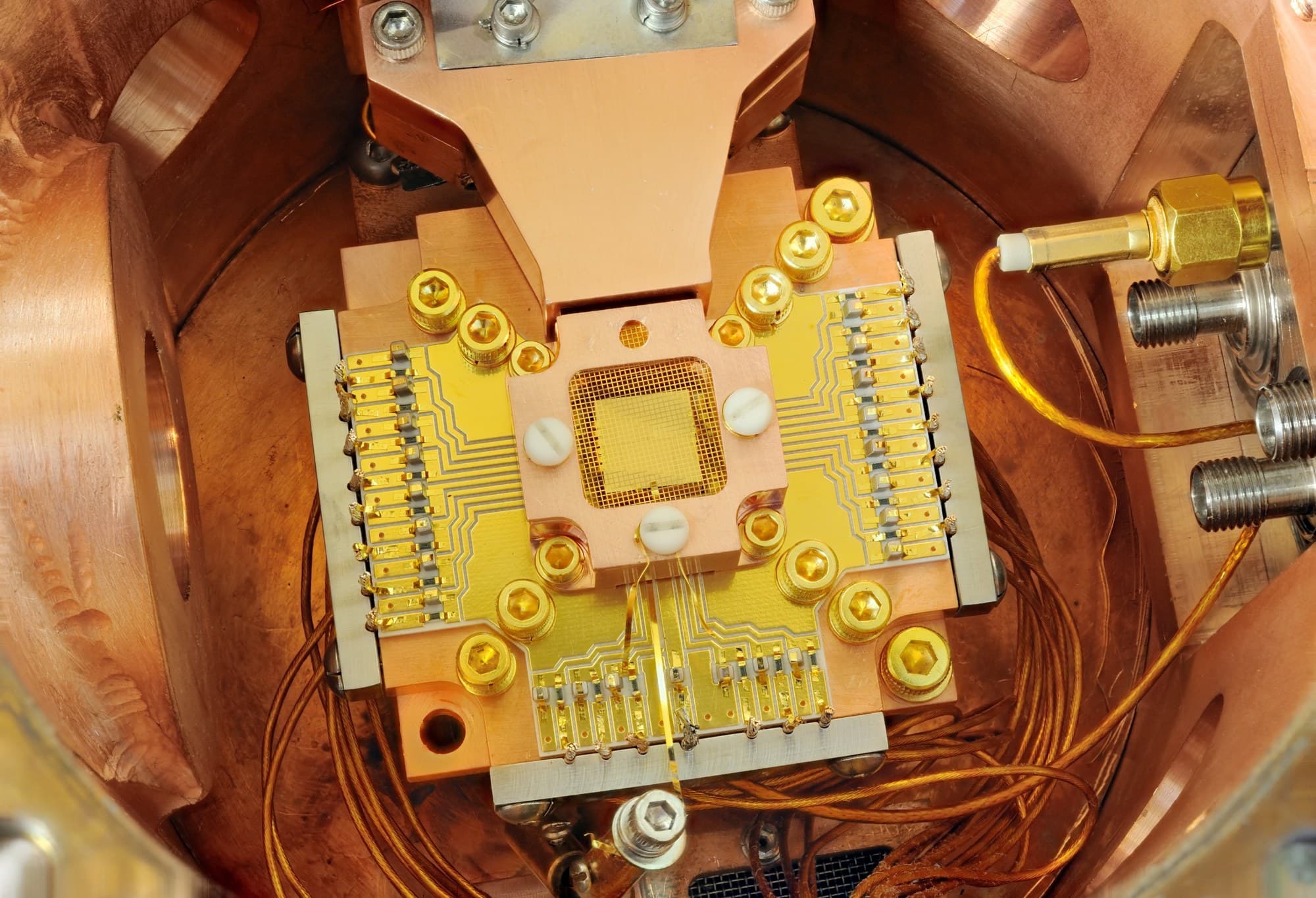
An ion-trap apparatus at the National Institute of Standards and Technology in which two beryllium ions are held about 40 micrometers apart above the square gold chip at center, February 2011. Helios also uses trapped ions, but this is a NIST research device, not Quantinuum hardware; the image is illustrative. Photo: Y. Colombe/National Institute of Standards and Technology, via Wikimedia Commons (public domain). Source page: https://commons.wikimedia.org/wiki/File:Quantum_Computing;_Ion_Trapping_(5941055642).jpg
Quantum computers store information in qubits that are easily disturbed, and error correction spreads a single "logical" qubit across many physical ones so that mistakes can be detected and repaired. The approach pays off only when the hardware is accurate enough, a level physicists call the threshold. Below it, making the code larger should suppress errors exponentially; above it, error correction adds more noise than it removes.
In the new experiments, run on Helios with code written in the company's Guppy programming language, the team used triangular color codes at distances of 3, 5 and 7, a measure of how much protection each code provides. At distance 7, Quantinuum said, the system achieved a logical fidelity of 99.9995 percent per round of error checking, a failure probability of 5 in a million. The suppression factor, known as Lambda, was 12, which the company described as the largest yet measured.
Measuring something that rarely fails takes patience. According to the blog post, the team ran 580,000 rounds, 29,000 runs of 20 rounds each, and observed three failures to establish the headline figure.
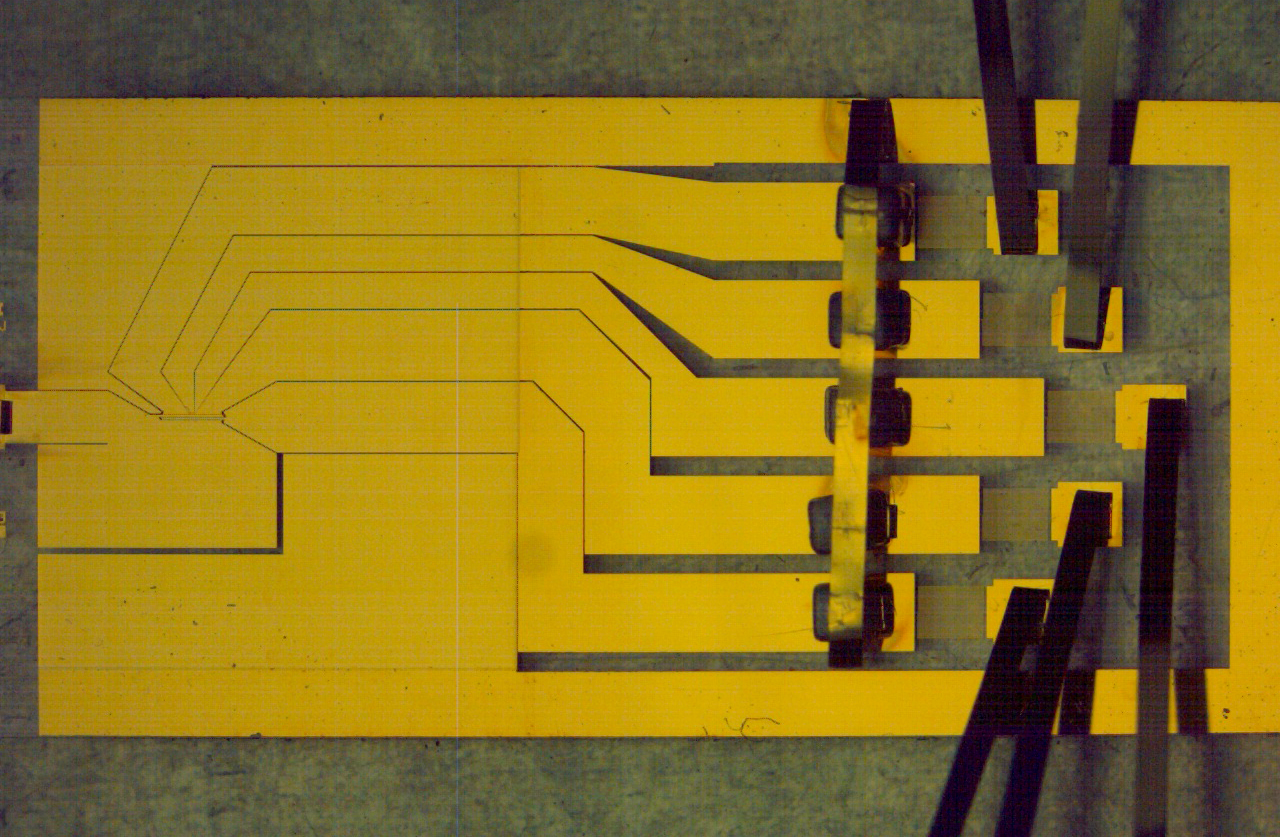
A planar ion trap developed at NIST, which uses gold electrodes to confine magnesium ions 40 micrometers above the surface of the chip, 2006. Illustrative of trapped-ion technology; not Quantinuum hardware. Photo: Signe Seidelin and John Chiaverini/National Institute of Standards and Technology, via Wikimedia Commons (public domain). Source page: https://commons.wikimedia.org/wiki/File:Planar_Ion_Trap_(5941086002).jpg
The company said the error rate was 10 times lower than the record it reported in September using a different scheme, its Helix code, on the same Helios machine, and 100 times lower than the best published result on any other kind of hardware, which it attributed to Google Quantum AI working with a superconducting system. The two codes trade accuracy for efficiency: Helix used 10 physical qubits per logical qubit, Quantinuum said, while the color code used up to 37.
The researchers also tested logical operations, not only memory. For two-qubit Clifford gates, a basic class of operations, errors fell by a factor of 9 when the code distance rose from 3 to 5, though the blog post notes that figure carries wide error bars, plus 8 or minus 4.
"With this result, we've proven that we have the error-correction architecture and trapped-ion technology required to achieve universal fault-tolerance," said Rajeeb Hazra, Quantinuum's chief executive.
Robin Blume-Kohout, co-director of the Quantum Performance Lab at Sandia National Laboratories, who was not involved in the study, called it "a significant milestone that quantum computing researchers have been working toward for many years." The paper, he said in the company's release, describes "a logical qubit nearly 100x better than its component physical qubits," and a scaled-up version of the system "could reach the reliability required for useful fault-tolerant computation at a feasible size." He added: "These findings go a long way to retire one of the field's central technical risks."
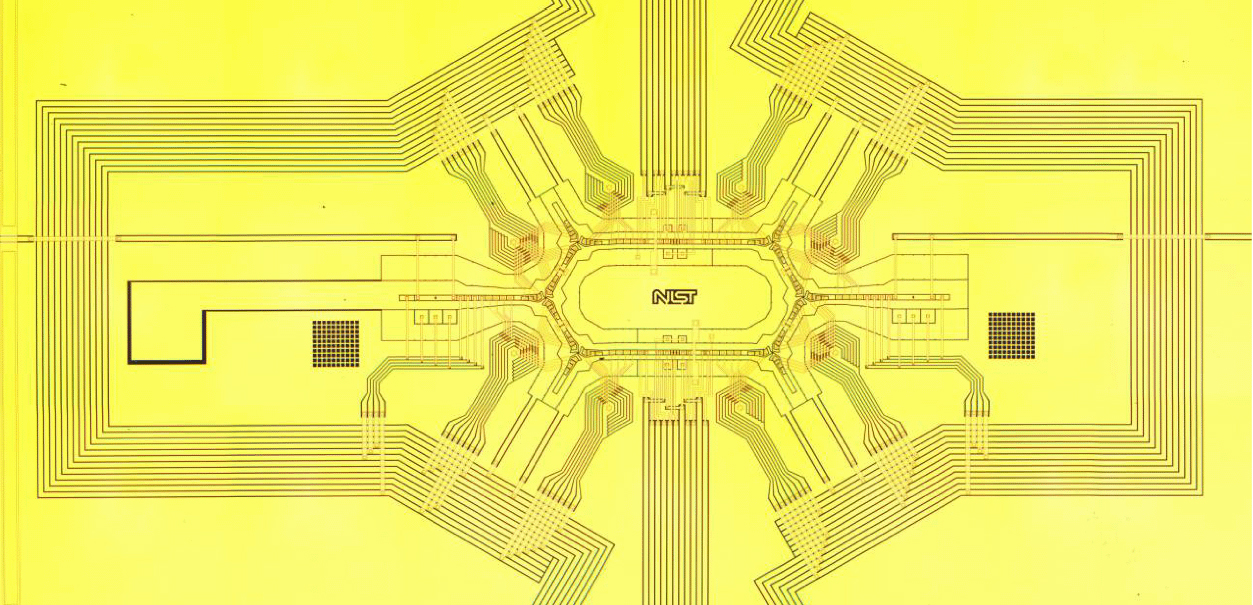
A NIST "racetrack" ion trap under development as possible quantum computing hardware, with 150 zones for storing, moving and probing ions in its central ring and six radiating channels, 2010. Illustrative; not Quantinuum's Helios. Photo: J. Amini/National Institute of Standards and Technology, via Wikimedia Commons (public domain). Source page: https://commons.wikimedia.org/wiki/File:Ion_Trap_(5941039382).jpg
Important work remains. The blog post acknowledges that no one has yet shown below-threshold scaling for magic state preparation, one of the three components a fully fault-tolerant processor built on this code would require. The company's broader claims, including a projection that its approach could need roughly 30,000 physical qubits where a superconducting design would need about 900,000 to support 100 high-accuracy logical qubits, are its own calculations based on extrapolating the measured trend.
Quantinuum, which trades on the Nasdaq, said the result puts its accuracy within the target range for Apollo, the universal fault-tolerant quantum computer it plans to make available by 2029. Apollo remains a plan rather than a product, and the company's release describes its timing as a forward-looking statement. A grid-shaped successor system called Sol is due next year, the blog post said.
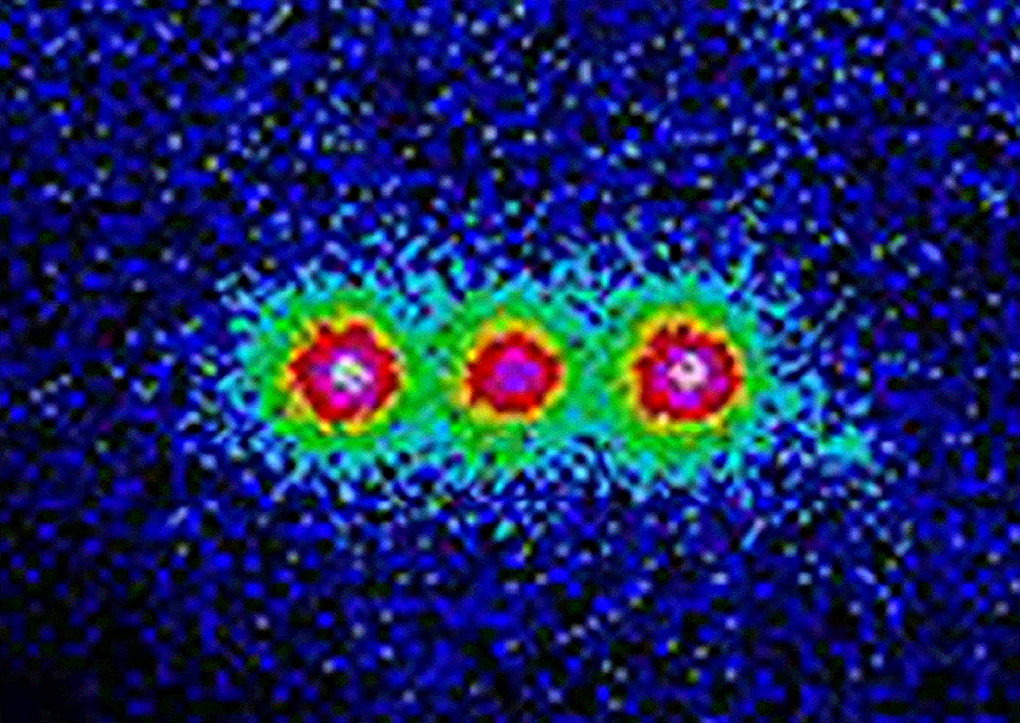
Colorized fluorescence from three trapped beryllium ions illuminated by an ultraviolet laser at NIST, 2005; brighter colors indicate higher intensity. Illustrative of trapped-ion qubits; not from the Quantinuum experiment. Image: National Institute of Standards and Technology, via Wikimedia Commons (public domain). Source page: https://commons.wikimedia.org/wiki/File:Fourier_Transform,_Beryllium_Ions_(5883951063).jpg
Sources: Quantinuum press release, "Quantinuum Breaks Error-Correction World Record by 10x, Validating its Leading Path to Fault-Tolerant Quantum Computing by 2029," 19 October 2026, https://www.quantinuum.com/press-releases/quantinuum-breaks-error-correction-world-record-by-10x-validating-its-leading-path-to-fault-tolerant-quantum-computing-by-2029 ; Quantinuum blog, "Quantinuum Closes In on One Million Error-Free Operations," 19 October 2026, https://www.quantinuum.com/blog/quantinuum-closes-in-on-one-million-error-free-operations ; A. Lavasani, A. P. Reed et al., "Quantum error correction well below the color code threshold," preprint, not peer reviewed, https://www.quantinuum.com/fault-tolerance-by-2029 . All results are company-reported. All images are public domain NIST photographs and are illustrative; none shows Quantinuum hardware.
- technology
- quantum-computing
- science
- physics
- research