A 17-year-old in Detroit built an app that pairs lonely seniors with after-school volunteers
NeighborHour started as a school project. It now logs thousands of visits in three cities, with teenagers earning service hours and older neighbors getting a knock on the door that is not a scam.
Jordan Hale, Technology reporter||3 min read
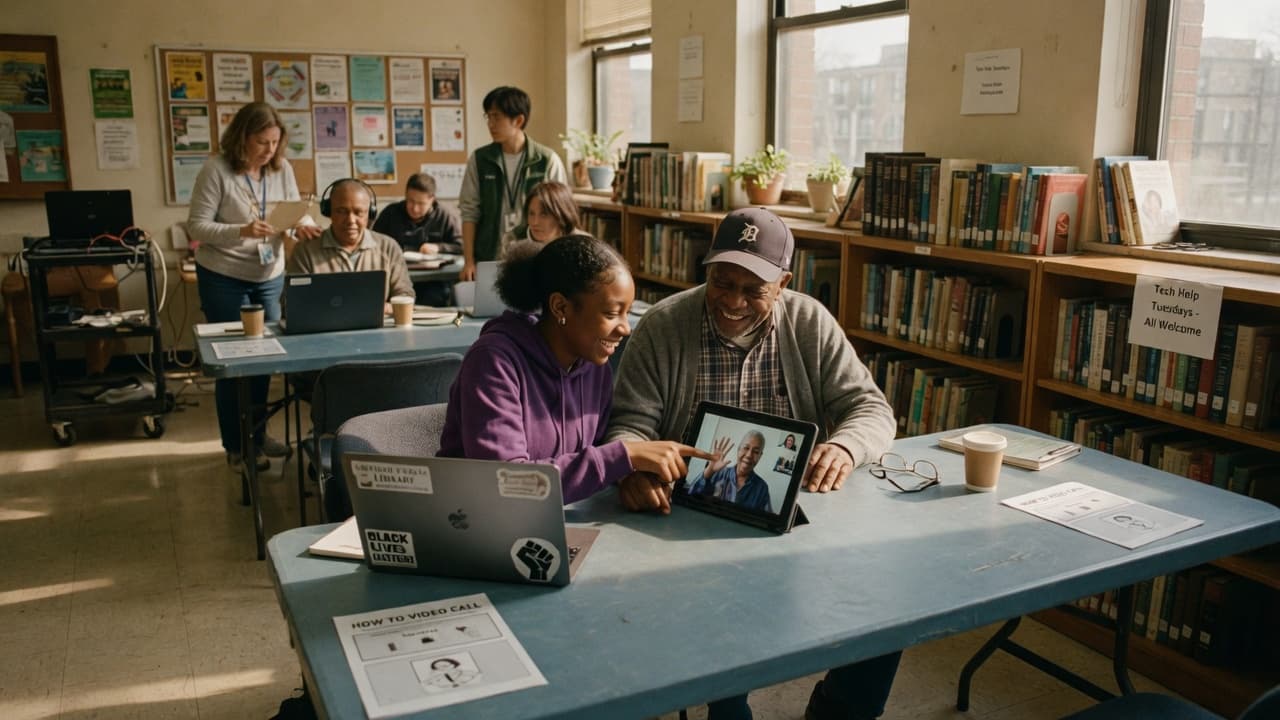
Maya Chen was 16, angry at a headline, and in need of a senior project. The headline was about older adults in her zip code who had gone days without a conversation. The project became NeighborHour, a deliberately small app: a senior requests a visit, a vetted student accepts, they meet in a public place or on a porch in daylight, and both tap a button when the hour is done.
Fourteen months later the app is live in Detroit, Grand Rapids, and Toledo. It has logged more than 8,400 completed visits. The median visit is 52 minutes. The most common activities, according to the in-app tags, are “walk,” “mail,” “video call with family,” and “cards.”
Chen, now 17 and a senior at Cass Technical High School, still does customer support from her kitchen table. “I did not want a feed,” she said. “Feeds make people perform. I wanted a calendar.”
Designed against the usual traps
NeighborHour refuses several features that make consumer apps grow. There is no public profile beyond a first name and a school or building. There are no likes. Students cannot message seniors until a visit is confirmed, and the thread closes 12 hours after it ends. Background checks for volunteers over 18 are handled by a nonprofit partner, Elders Connected. Minors need a parent plus a school coordinator.
The boring constraints are the product. Scams targeting older adults often impersonate helpers. Chen’s answer is a closed loop: visits are scheduled through senior centers and public libraries, not through cold invites. Librarians in three Detroit branches now keep a tablet at the reference desk specifically for NeighborHour sign-ins.
“We have had plenty of apps that promised connection and delivered a login screen,” said Denise Porter, who runs programming at the Parkman Branch. “This one produces a person on a Tuesday.”
Students get what they need too. Michigan’s service-hour requirements, and similar rules in Ohio, turned the app into something counselors can actually recommend. A completed visit exports a signed PDF. Teachers at Cass Tech and two other schools made NeighborHour an approved activity, which solved the chicken-and-egg problem of a teen social product that is not social.
What an hour does
On a humid afternoon at Parkman, Chen sat with Harold Jenkins, 81, who wanted help joining his granddaughter’s birthday call. The call lasted 19 minutes. Afterward Jenkins asked Chen how to save the contact “so I do not have to be brave every time.” She put a large icon on his home screen. That was the visit.
Jenkins has booked seven hours since May. “I am not helpless,” he said. “I am outnumbered by menus.”
A University of Michigan public-health class surveyed 120 seniors after six or more visits. Seventy-one percent said they felt “less isolated than last year.” That is self-report, not a clinical trial. Chen puts the PDF on the app’s about page anyway, under a heading that reads “Not magic, measured.”
Funding is a patchwork: a Knight Foundation prototype grant, a city digital-inclusion stipend, and a $25,000 prize from a high-school venture fair that Chen almost skipped. She has not taken venture capital. “The moment I optimize for growth, I will start sending notifications that feel like guilt,” she said. “Guilt is not a civic good.”
A teenage founder, a public tool
There is a version of this story that turns Chen into a mascot. She is wary of it. She wants the code in the hands of the libraries if she leaves for college. The repository is already public. A volunteer developer in Ann Arbor added large-type mode. A Spanish-language interface shipped in August.
The next city on the list is Cleveland, if a library system says yes. The waitlist is not a landing page with a rocket emoji. It is a form that asks who will sit at the reference desk.
“People think technology is the opposite of knocking on a door,” Chen said, packing the library tablet back into its case. “I think it is a way to make sure the knock happens.”
- community
- aging
- detroit
- education