Astronomers Find the First Known Green Star, a Stellar Remnant Tinted by the Debris of Its Own Planets
University of Warwick astronomers report that the white dwarf WD J1330+6435, its dense atmosphere enriched with sodium, lithium and calcium from accreted rocky material, would appear chartreuse green to the human eye, which they describe as the first genuinely green star known. The study, in RAS Techniques and Instruments, finds that about one in thirty white dwarfs would shine in an unusual colour, though the typical white dwarf really is white.
Just News Desk, Correspondent||6 min read
COVENTRY, England - A small, burned-out star whose atmosphere has been laced with sodium, lithium and calcium from shattered rocky bodies would glow a ghostly chartreuse green to the human eye, astronomers at the University of Warwick have reported. As far as the researchers are aware, no other star, living or dead, has ever been credibly reported as green, making the white dwarf WD J1330+6435 the first known genuinely green star in the Galaxy.
The finding, announced by the university on 15 October, comes from a study published in the journal RAS Techniques and Instruments under the title "Any colour you like: The diverse chromaticities of white dwarfs." It shows that some of these dense stellar remnants, if they could be viewed up close, would shine in colours that ordinary stars do not display, including green, pink, cyan, yellow and purple.
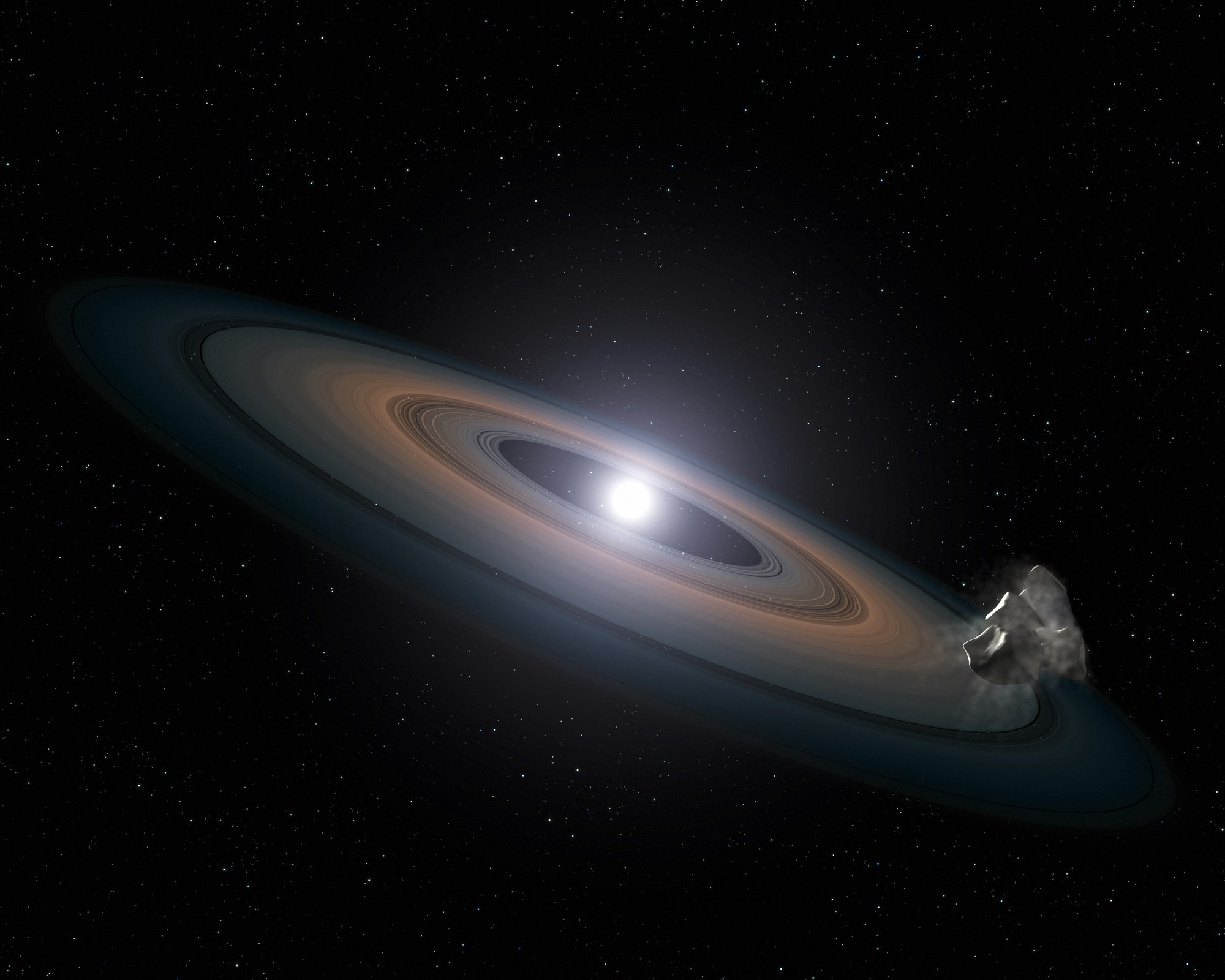
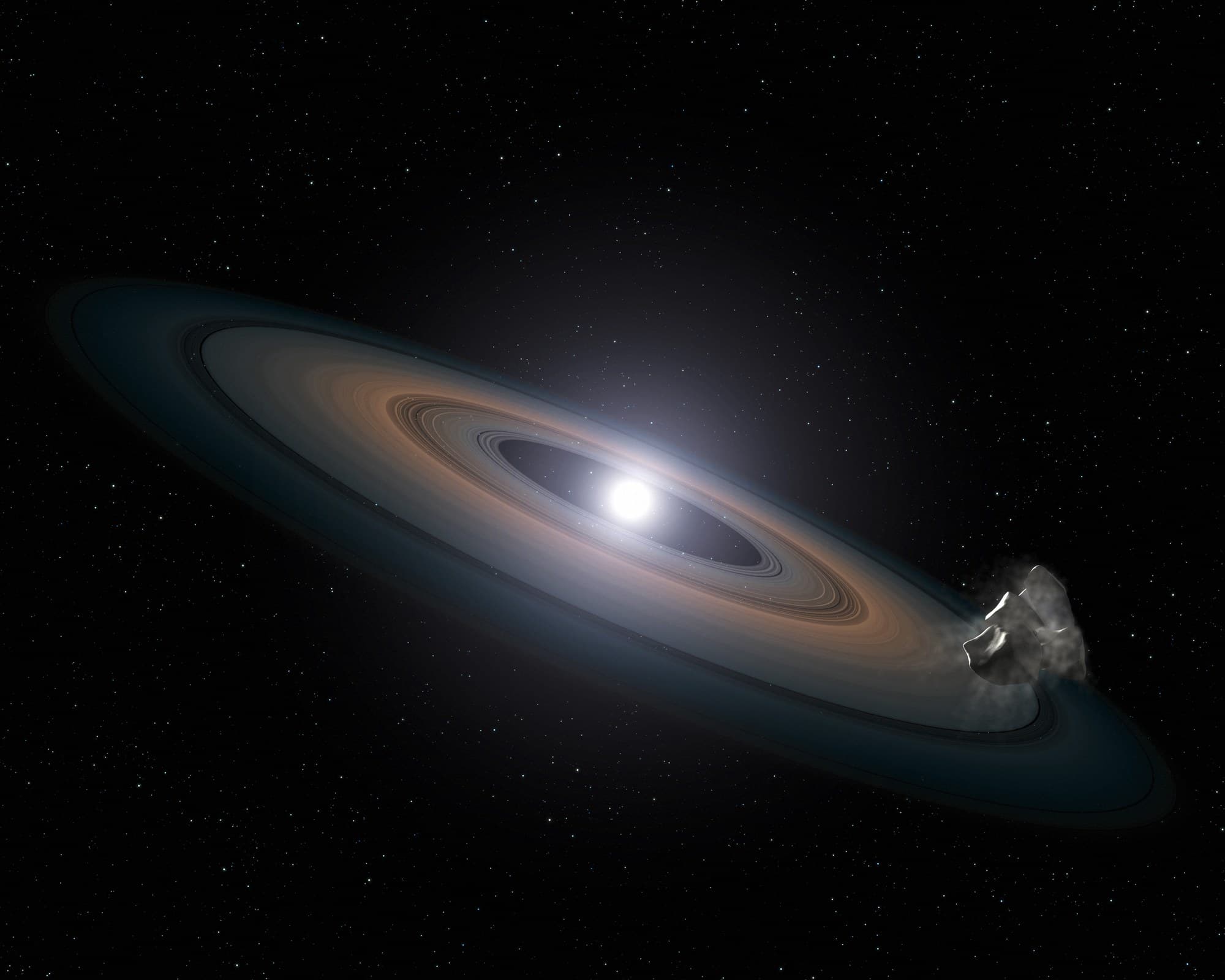
An artist's impression of a white dwarf accreting rocky debris left behind by its surviving planetary system, released in 2013 alongside Hubble Space Telescope observations of white dwarfs in the Hyades star cluster. The image shows a different white dwarf, not WD J1330+6435, and illustrates the kind of process the Warwick team describes. Illustration: NASA, ESA, STScI and G. Bacon (STScI), via Wikimedia Commons (CC BY 4.0). Source page: https://commons.wikimedia.org/wiki/File:Artist%E2%80%99s_impression_of_debris_around_a_white_dwarf_star.jpg
For most stars, colour is a guide to temperature: cooler stars look orange, stars like the Sun look white, and the hottest glow pale blue. White dwarfs, the dense remnants left behind when Sun-like stars reach the end of their lives, were thought to follow the same rule. The Warwick work suggests they do not always.
"Most stars, including most white dwarfs, behave like 'perfect radiators,' so their colour is set almost entirely by temperature. But nobody had really looked into what else might be possible for white dwarfs," said Dr. Mark Hollands, a Warwick Prize Fellow in the university's Astronomy and Astrophysics Group, who led the work. "It turns out these incredibly dense stars can produce colours nobody expected, and some of them genuinely surprised me."
The explanation, the university said, is density. The coolest white dwarf atmospheres can reach around one gram per cubic centimetre, roughly the density of water and millions of times denser than the visible surface of the Sun. Under those conditions, trace elements such as carbon, calcium and sodium interact with the surrounding helium plasma and absorb light across a wider range of colours than they otherwise would, pulling a star's colour away from the usual orange, white and blue.
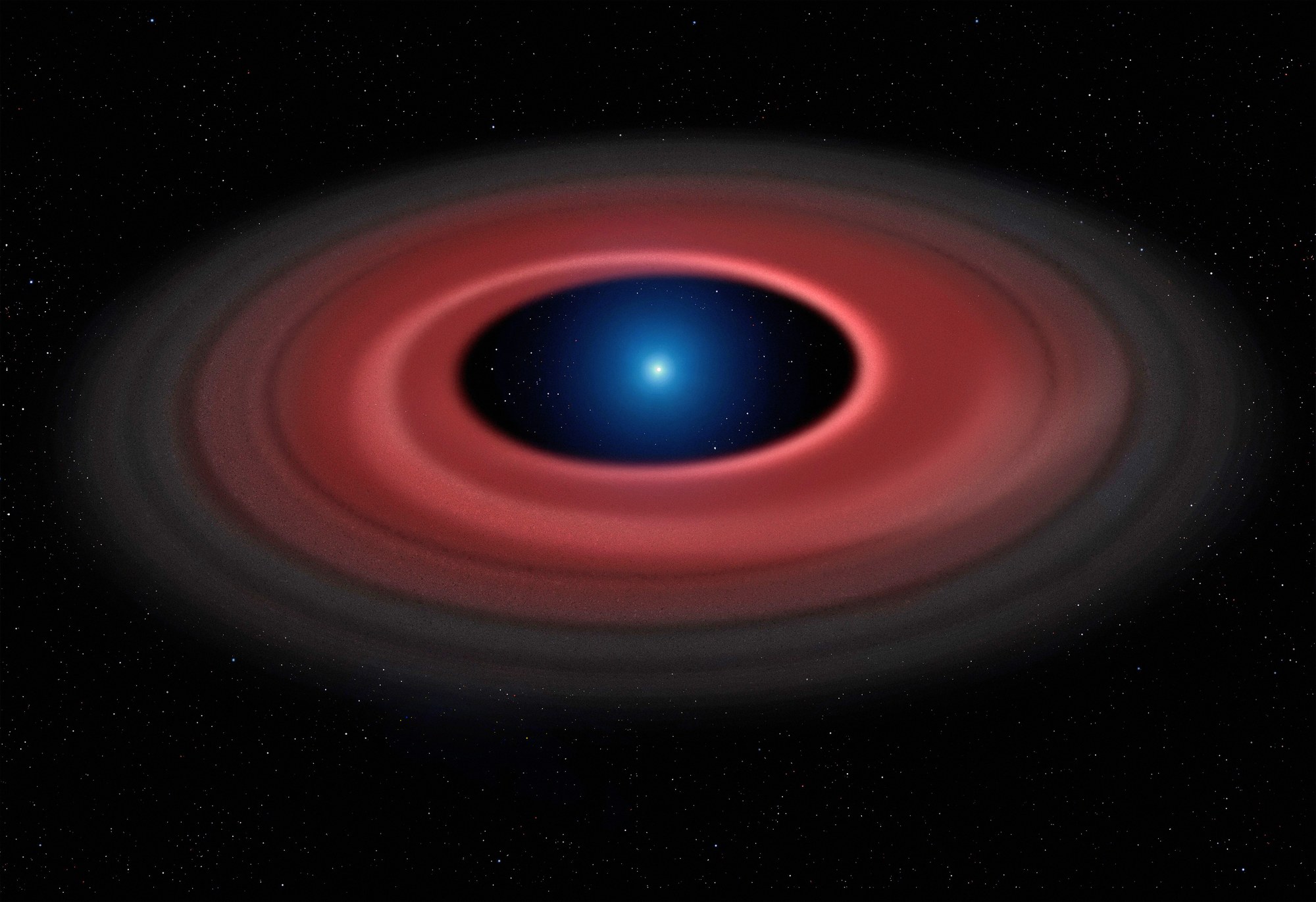
An artist's impression of a disc of dust and debris, formed from an asteroid torn apart by gravity, orbiting the white dwarf SDSS J1228+1040, released by ESO in 2015. It shows a different star from the one in the new study. Illustration: Mark Garlick (www.markgarlick.com) and University of Warwick/ESO, via Wikimedia Commons (CC BY 4.0). Source page: https://commons.wikimedia.org/wiki/File:Artist%E2%80%99s_impression_of_the_glowing_disc_of_material_around_the_white_dwarf_SDSS_J1228%2B1040.jpg
No white dwarf is close enough for its colour to be seen directly, so the team calculated colours from data astronomers already collect routinely: each star's spectrum, the pattern produced when starlight is split by wavelength. Running those spectra through a model of human colour vision showed how each star's light would appear to the eye.
WD J1330+6435, which is roughly 4,000 degrees Celsius, has accreted rocky material from its planetary system, enriching its atmosphere with calcium, lithium and sodium and giving it a chartreuse green appearance in the team's models, according to the university.
"The traces of sodium in the atmosphere of this white dwarf absorb the orange part of the spectrum, leaving behind a ghostly green glow," Dr. Hollands said. "Imagine standing on a planet and looking up at a green star. It feels like something out of science fiction."
Across the sky, the researchers found that white dwarf colours fall into distinct groups tied to what each star's atmosphere contains. Carbon-rich white dwarfs are typically pink or purple. Those enriched with debris from shattered asteroids and comets, the remains of old planetary systems, tend toward yellow. Cooler white dwarfs with mixed hydrogen and helium atmospheres often take on a cyan or pale blue tinge.
At the other extreme, the team identified what may be the reddest star ever recorded: WD J1011+2845, a white dwarf 48 light years from Earth, where a deep convection zone has lifted carbon from the core to the surface. The resulting carbon molecules squeeze almost all of its light into wavelengths beyond 600 nanometres, producing what the university described as a deep salmon-pink glow.
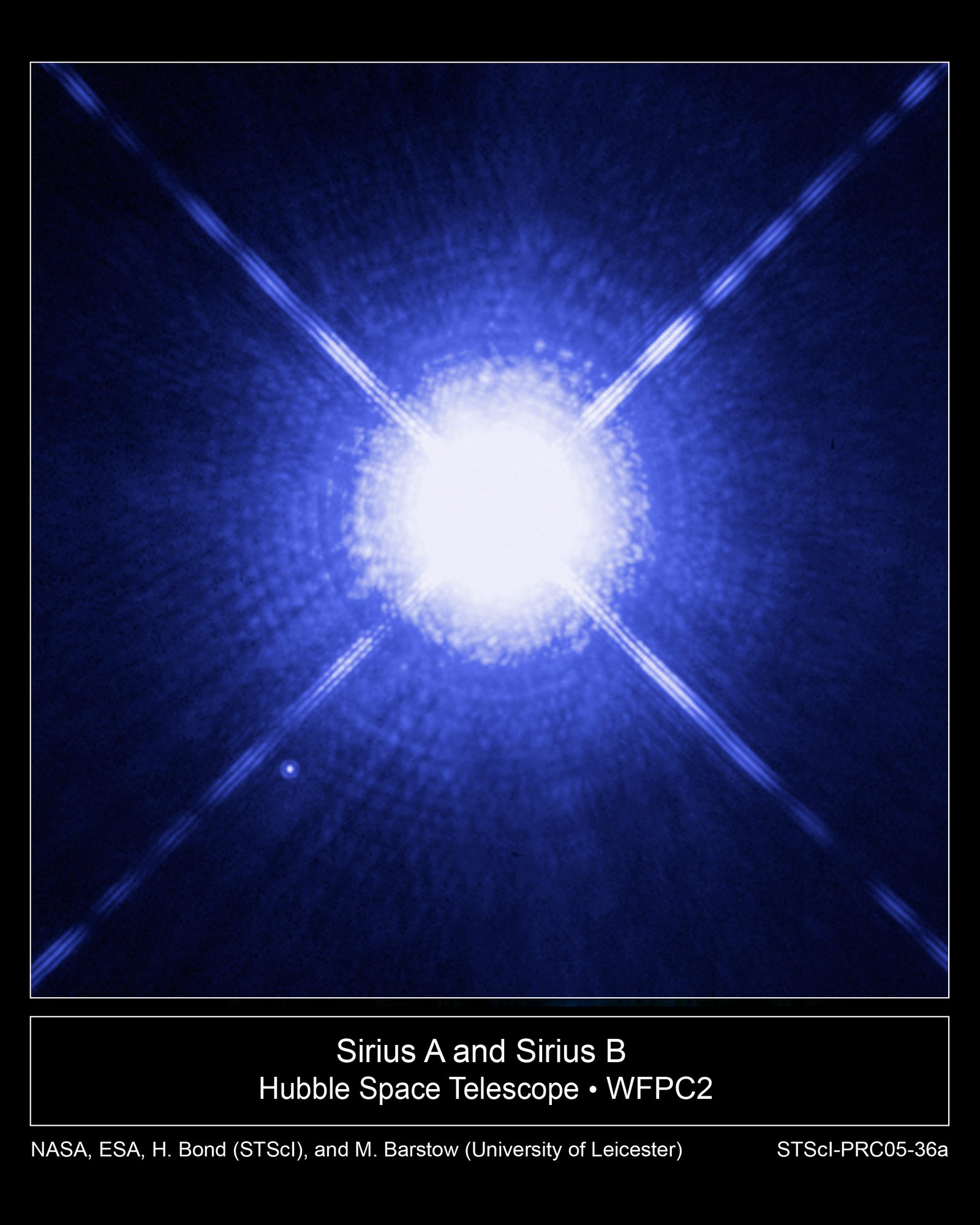
Sirius A, the brightest star in the night sky, and its faint companion Sirius B, the nearest white dwarf to the Solar System, seen as a tiny dot at lower left in this 2005 Hubble Space Telescope image. Sirius A is deliberately overexposed. The Warwick team's models give Sirius B, with its hot hydrogen atmosphere, a pale blue colour. Photo: NASA, H.E. Bond and E. Nelan (Space Telescope Science Institute); M. Barstow and M. Burleigh (University of Leicester); and J.B. Holberg (University of Arizona), via Wikimedia Commons (public domain). Source page: https://commons.wikimedia.org/wiki/File:The_Dog_Star,_Sirius,_and_its_Tiny_Companion_(2005-36-1820).jpg
The unusual colours are not the norm. In a representative sample of the 151 white dwarfs within 20 parsecs, or about 65 light years, of Earth, five showed unusual colouring, two yellow and three pink, suggesting that roughly one in thirty white dwarfs in the universe shines with an unusually coloured light. For the remaining 146, the median colour temperature was about 6,800 Kelvin, which the eye perceives as white.
That result, the researchers said, corrects a common misconception that white dwarfs are typically blue. Hotter, bluer white dwarfs are brighter and can be seen from farther away, so they are over-represented in surveys that rely on brightness alone.
"One in thirty might not sound like a huge fraction, but across the entire population of white dwarfs in the Universe, that is still a lot of oddly coloured stars out there," said Professor Boris Gänsicke of Warwick's Department of Physics. "Yet if we take the median across a representative population of white dwarfs, we found that the average white dwarf really is white."
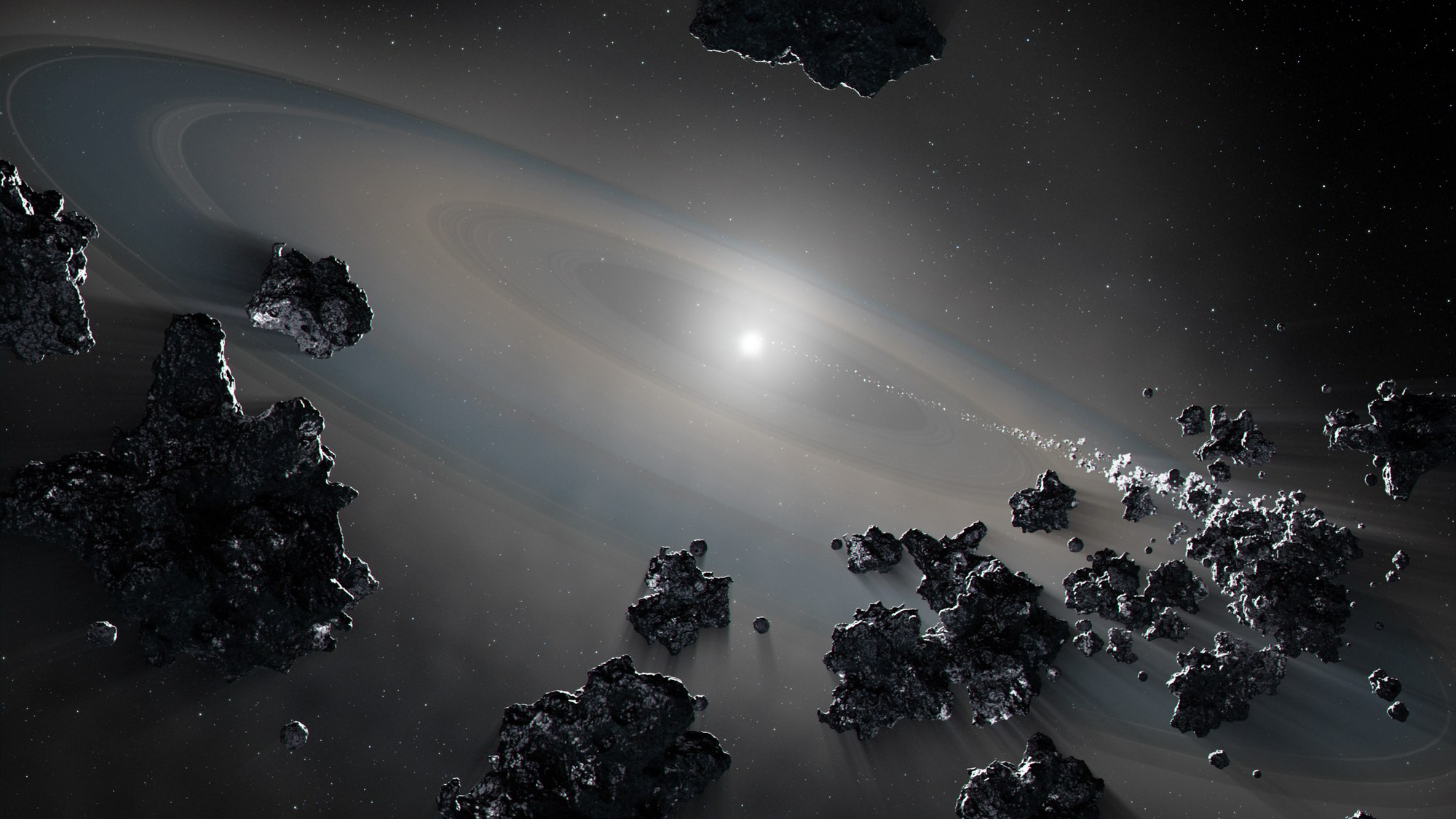
An illustration of the white dwarf G238-44 siphoning debris from shattered objects in its planetary system, released in 2022 with Hubble Space Telescope findings. It depicts a different white dwarf and is shown to illustrate how rocky material can reach a white dwarf's atmosphere. Illustration: NASA, ESA, Joseph Olmsted (STScI), via Wikimedia Commons (public domain). Source page: https://commons.wikimedia.org/wiki/File:Material_Accreting_onto_the_White_Dwarf_G238-44_(2022-026).jpg
The colours are calculated rather than photographed, since none of these stars is near enough to be seen directly. Even so, the university said, the work is a reminder of how much a spectrum can reveal: not only a star's temperature and chemical makeup, but its true colour as well.
Sources: University of Warwick press release, "Green, pink and purple: astronomers reveal the surprising true colours of white dwarf stars," 15 October 2026, https://warwick.ac.uk/news/pressreleases/astronomers-reveal-true-colours-of-white-dwarf-stars/ ; Hollands et al., "Any colour you like: The diverse chromaticities of white dwarfs," RAS Techniques and Instruments, doi:10.1093/rasti/rzag069. Images are illustrative and openly licensed; none depicts WD J1330+6435.
- science
- astronomy
- space
- white-dwarfs
- discovery