A silent Yorkshire mill is now 90 studios for artists who could not afford London
The old Ridgeway Spinning Mill in Calderdale reopened as a community land trust: affordable workrooms, a Saturday market, and a town that got its Saturday back.
Mateo Alvarez, Culture correspondent||3 min read
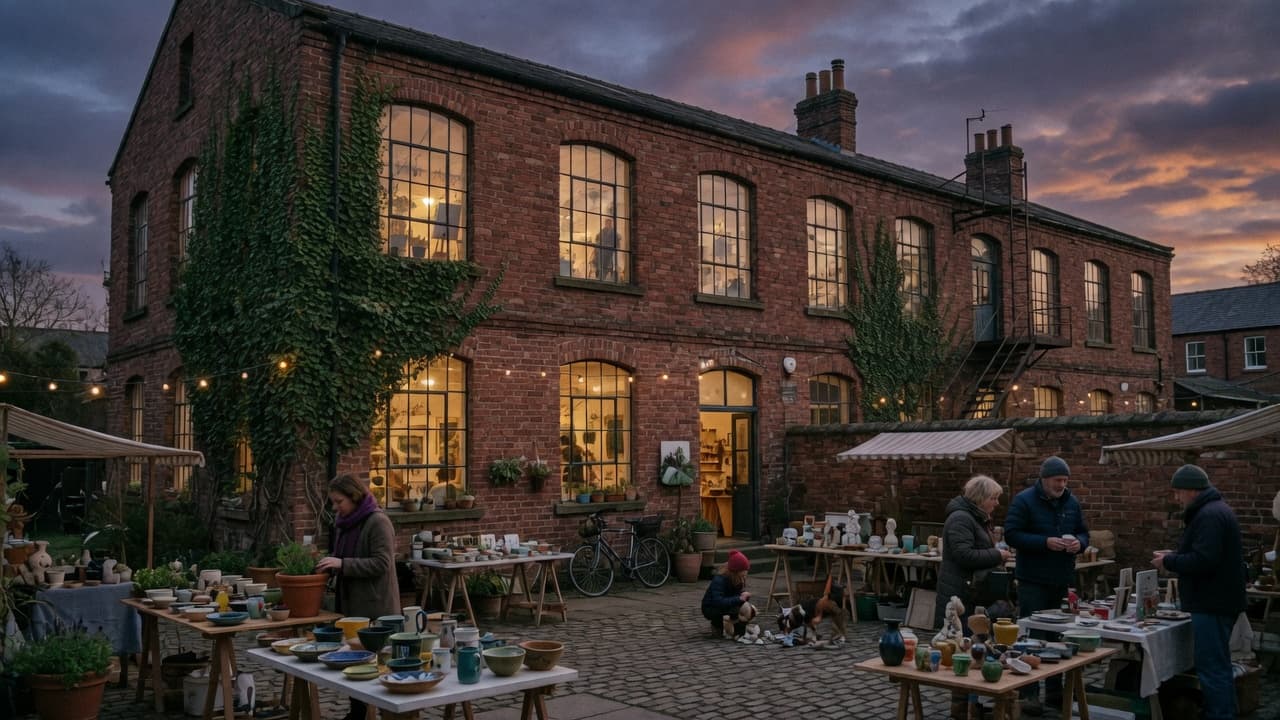
For 26 years the Ridgeway Spinning Mill in Mytholmroyd was a brick cliff with broken panes. Pigeons kept the only regular hours. On a Saturday in September the courtyard held a ceramicist, a man selling oatcakes, a brass trio from the high school, and a queue for coffee that moved like a village with nowhere else it would rather be.
The mill now holds 90 working studios, 12 apartments reserved for people who work on site, and a ground-floor hall that the parish books for funerals and birthday discos. It is owned by the Calder Valley Land Trust, which exists so that the building cannot be flipped into weekend flats the moment the photographs look good.
Rents are indexed to local wages, not to London. A painter pays £220 a month for a north-light room that would be a punchline in Hackney. In exchange she keeps hours, contributes to the Saturday open-studio rota, and does not sublet to a lifestyle brand.
How a ruin became a lease
The trust bought the mill from a holding company that had run out of patience and ideas. The price was not a steal; it was possible because Historic England listed the building, which scared off the most extractive bidders, and because the council leased the car park for a pound a year. A patchwork of community shares, a lottery grant, and a patient loan from a regional bank closed the gap.
Architect Priya Desai kept the iron columns and refused to sandblast the brick into a café aesthetic. “If it looks like a spa, we have lost,” she said. Insulation went in. Windows that can actually open went in. A freight lift that can take a kiln went in. Beauty was a byproduct of usefulness.
The waiting list hit 400 before the first keys were cut. Priority went to applicants already in Calderdale, then to those being priced out of Leeds, then to a handful of London leavers who could show they would stay. The trust publishes the criteria. Arguments continue, which is a sign of a real allocation, not a marketing raffle.
A town with a Saturday
Mytholmroyd is not a blank canvas. It is a place that lost a mill and kept the weather. Shopkeepers on the high street say Saturday footfall is the highest in a decade. The butcher stays open an extra hour. A teenager we interviewed, Ella Wright, 16, had a stall of lino prints and a card reader. “I thought art was a train to somewhere else,” she said. “Turns out it can be a bus to here.”
There are tensions. A few residents wanted parking, not pottery. The trust answered with a residents’ liaison night that is poorly attended and still exists. Noise rules are posted on every landing. A weaver and a drum teacher had a dispute in June; they now split the afternoon.
None of this is a creative-class fairy tale. It is industrial reuse with a legal structure that makes greed inconvenient. If the photographs go viral, the rents still cannot follow them. That clause is the story.
On the way out, the courtyard lights came on in the old loading bay. A man in a high-vis vest — a trust caretaker, not a security theater — locked the side gate and nodded at a dog. The mill, for the first time in a generation, had a closing time instead of an ending.
- community
- arts
- housing
- britain